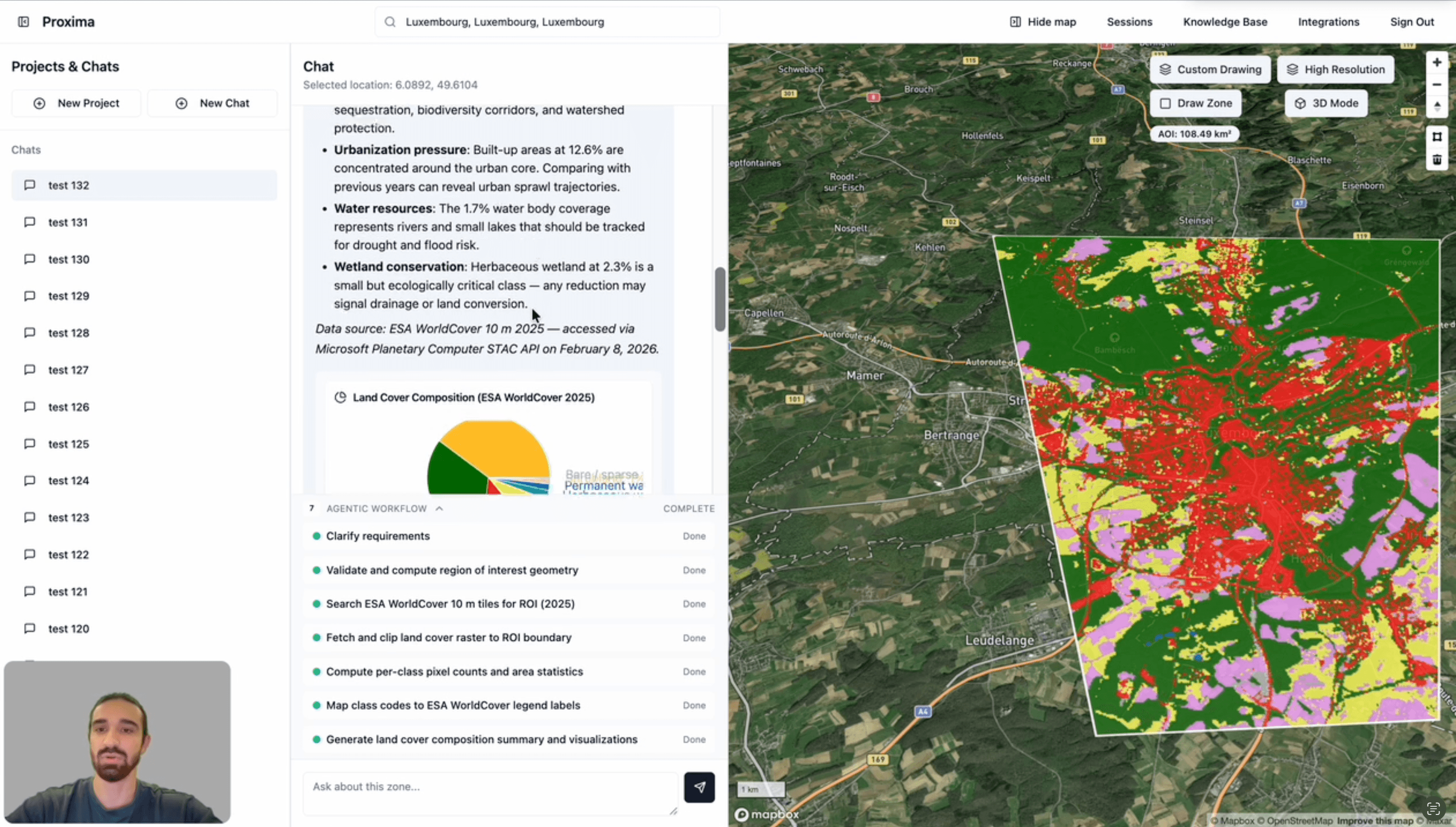
Proxima analysis workspace
A multi-agent GIS session that combines map-driven analysis, evidence-backed reasoning, and presentation-ready spatial outputs in one workflow.

Proxima was where AI product design, spatial analysis, and platform trust had to work as one system. The challenge was not only answering geospatial questions. It was coordinating the right agents, grounding outputs in evidence, and turning the result into visuals people could actually use in operational decisions.
Selected screens from the shipped product
Proxima analysis workspace
A multi-agent GIS session that combines map-driven analysis, evidence-backed reasoning, and presentation-ready spatial outputs in one workflow.
As a co-founder, I worked at the intersection of product direction and technical execution. The platform had to support tenant isolation, flexible customer workflows, and a path to monetization from the start.
That shaped many early decisions around data boundaries, execution models, and the kinds of abstractions we could afford to build. We needed enough structure to move quickly without painting ourselves into a corner.
At the core, Proxima was a multi-agent platform for analyzing GIS imagery and structured spatial data. I used LangGraph and LangChain to orchestrate specialist agents, then designed a dynamic agent layer that could adapt the execution path based on the region, task, and evidence required.
That mattered because geospatial work rarely fits a single linear prompt. The system had to break work into steps like geometry validation, imagery lookup, raster analysis, evidence gathering, and synthesis while still feeling like one coherent product to the user.
Text alone was not enough. Users needed outputs they could inspect visually, including pixel-accurate map overlays, charts, bars, and report-ready summaries that made spatial change easy to understand.
That visual layer had to stay tied to evidence. I treated citations, confidence signals, audit logs, RBAC, RLS, and usage-aware access control as part of the same product surface so the platform stayed usable without becoming opaque or risky.